
Have you ever wondered why certain challenges keep showing up even when you’re trying your best to deal with them?
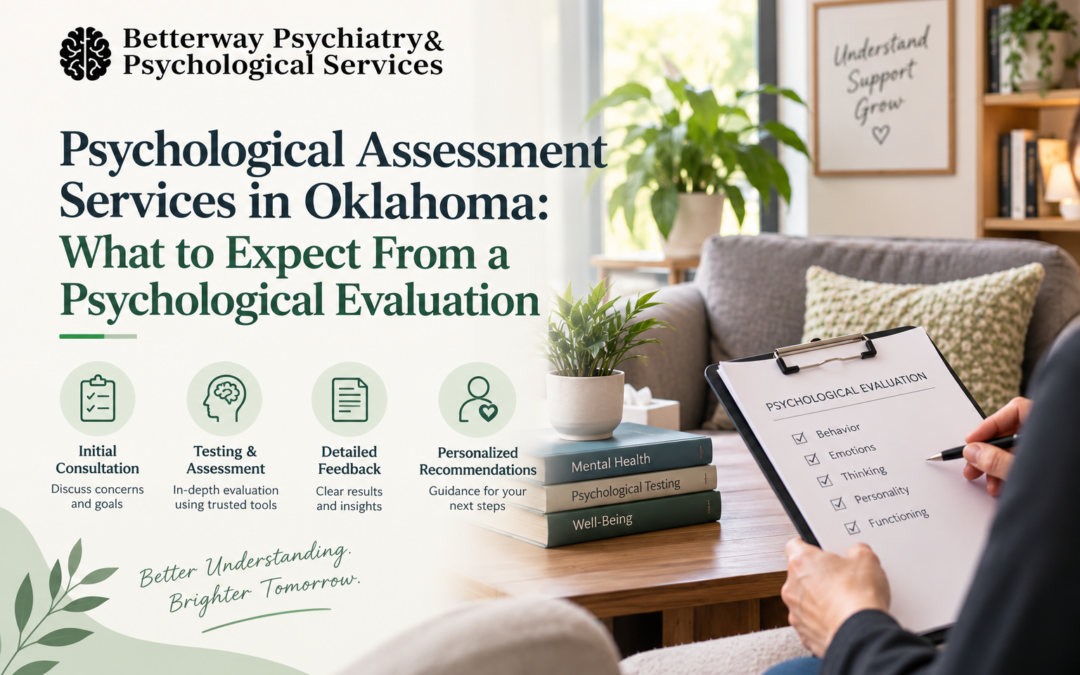
Psychological Assessment Services in Oklahoma: What to Expect From a Psychological Evaluation
Maybe you’re struggling to concentrate, finding everyday tasks unusually difficult, or trying to understand patterns in your thoughts and behavior. Sometimes, the hardest part isn’t knowing that something feels different; it’s understanding why.
That is where psychological assessments can provide valuable insight.
Psychological assessment services are designed to use structured evaluations and professional expertise to better understand an individual’s cognitive, emotional, behavioral, and psychological functioning. For someone considering a psychological evaluation in Oklahoma, knowing what to expect can make the process feel much less intimidating.
What Is a Psychological Evaluation?
A psychological evaluation is a structured process designed to collect information about a person’s psychological functioning. It may involve interviews, standardized tests, questionnaires, behavioral observations, and a review of relevant background information.
Think of it as putting together pieces of a puzzle. One questionnaire or test rarely tells the whole story. Instead, qualified professionals consider multiple sources of information to develop a more complete picture.
Depending on the individual’s concerns, an evaluation may explore areas such as:
- Attention and concentration
- Memory and cognitive functioning
- Emotional well-being
- Behavioral patterns
- Personality characteristics
- Developmental concerns
- Social and interpersonal functioning
The specific assessment process depends on the reason for the evaluation.
Why Might Someone Need a Psychological Assessment?
Psychological testing isn’t only for people who already have a diagnosis. Sometimes, the purpose is to gain clarity when something doesn’t quite make sense.
A person might want to have an assessment because they are experiencing:
- Ongoing difficulties with attention or organization
- Emotional or behavioral concerns
- Challenges related to learning or development
- Symptoms associated with trauma
- Questions about ADHD or Autism Spectrum Disorder
- Personality-related concerns
- Difficulties that are affecting school, work, or relationships
An evaluation can provide information that helps professionals better understand these concerns and consider appropriate next steps.
What Happens During a Psychological Evaluation?
One of the biggest questions people have is, “What actually happens during the evaluation?” The answer depends on the type of assessment, but the process generally involves several components.
1. Initial Discussion
The process may begin with a conversation about your concerns, background, symptoms, goals, and relevant experiences. This gives the professional important context before selecting or interpreting assessment measures.
2. Psychological Testing
You may complete standardized tests, questionnaires, or other assessment activities. These can examine different aspects of psychological or cognitive functioning.
There isn’t necessarily a “right” personality or perfect score you’re expected to achieve. The purpose is to gather meaningful information, not to pass or fail.
3. Professional Interpretation
Test results don’t simply speak for themselves. A review of the results is performed in conjunction with your history, reported concerns, observations, and other relevant information by a qualified professional.
This professional interpretation is an important part of making the evaluation useful rather than simply producing a collection of scores.
4. Results and Recommendations
After the assessment process, findings can be discussed with you. Depending on the evaluation, recommendations may include additional support, therapy, further assessment, or other appropriate resources. Book your appointment here to discuss your assessment needs and next steps.
What Can Psychological Testing Help Identify?
Psychological assessments can be used for a variety of concerns. At Betterway Psychiatry and Psychological Services, psychological testing may help evaluate concerns such as ADHD, Autism Spectrum Disorder, PTSD, personality disorders, and other psychological conditions.
The purpose isn’t to put a label on every difficulty you experience. Instead, assessment can provide greater clarity about patterns that may otherwise be difficult to understand.
Is a Psychological Evaluation Something to Be Nervous About?
It’s completely normal to feel a little uncertain before an evaluation. You may wonder whether you’ll give the “wrong” answer or whether the results will say something unexpected. Remember that psychological assessment isn’t a test of your worth, intelligence, or character.
The best approach is simply to be honest and answer questions as accurately as you can. A few ways to prepare include:
- Get adequate rest beforehand when possible.
- Bring relevant questions or concerns.
- Share important background information with your provider.
- Ask for clarification if you don’t understand an instruction.
- Avoid trying to predict what a particular answer “should” be.
Why Professional Interpretation Matters
Online quizzes can be fun. A five-minute questionnaire might even make you think, “That sounds exactly like me!” However, an online quiz isn’t the same as a professional psychological evaluation.
Reliable assessment involves appropriate tools, clinical knowledge, relevant history, and professional interpretation. Qualified providers understand that test results should be considered within the context of the individual rather than viewed in isolation.
This evidence-informed approach helps make psychological assessment services more meaningful and useful for the person seeking answers.
Taking the Next Step With Greater Clarity
You don’t need to know exactly what’s happening before asking for help. In fact, uncertainty is often one of the reasons people seek an evaluation in the first place. A psychological evaluation in Oklahoma can provide a structured opportunity to explore concerns, understand patterns, and gather information that may guide future care.
Whether you’re seeking answers about attention, behavior, emotional experiences, development, or another concern, an evaluation can be an important step toward understanding yourself more clearly.
At Betterway Psychiatry and Psychological Services, the focus is on individualized care that considers the person, not simply a set of test results.
Frequently Asked Questions
1. What is included in a psychological evaluation?
A psychological evaluation may include interviews, standardized tests, questionnaires, observations, and a review of relevant background information. The exact process depends on the purpose.
2. Who can benefit from psychological assessment services?
People experiencing concerns related to attention, behavior, emotions, development, learning, or other psychological difficulties may benefit from an assessment. Testing can provide greater clarity about these concerns.
3. Can a psychological evaluation diagnose ADHD?
A detailed evaluation can help assess symptoms and patterns associated with ADHD. A qualified professional considers test results alongside history and other relevant information before reaching clinical conclusions.
4. How long does a psychological evaluation take?
The timeline varies depending on the type and purpose of the evaluation. Some assessments may require multiple appointments to gather and interpret all relevant information.
5. What should I do to prepare for a psychological evaluation?
Try to get adequate rest, bring relevant information, and think about the concerns you want to discuss. Most importantly, answer questions honestly rather than trying to give a particular “correct” response.